How to switch your cat to a new litter: a 6-day plan and what the research says
Cats don't like sudden change, and their litter is one of the most important things in their home. Switch it overnight and some cats will start going next to the box. The good news: this is easy to avoid if you introduce the new litter gradually.
In short
- Mix the new litter with the old and increase its share every two days: 25%, 50%, 75%, 100%.
- In a 2022 study, a 6-day transition like this didn't change the cats' toilet habits.
- For a fussy cat, put a second box with the new litter next to the old one.
- Scoop clumps every day: cats avoid boxes with visible waste.
- If your cat goes outside the box for more than a few days, pause the switch and talk to your vet.
Why cats are sensitive to litter changes
A cat chooses where to go based on how the litter looks, smells and feels under its paws. Once it has accepted a litter, it treats it as its own, so a sudden switch is like having the furniture rearranged in a dark room. The Merck Veterinary Manual notes that sudden changes in litter type or box location can lead a cat to go elsewhere, and that once you find a litter your cat accepts, it's best not to change it without good reason.
So if you're switching litter – say, from bentonite to tofu – what matters most is not what you choose but how you make the switch.
What the research shows: a 6-day transition
Researchers at the University of Guelph (Canada) tested the often-repeated advice to switch litter over 6 days and published their results in the journal Animals. The study involved 16 adult shelter cats split into two groups of 8.
- What was switched: from clumping clay (bentonite) litter to a clumping plant-based (corn) litter.
- How: every two days the share of plant litter went up by 25%: 25% on day 0, 50% on day 2, 75% on day 4 and 100% on day 6. The cats then used only the new litter for another 8 days.
- What was measured: video cameras recorded how often the cats urinated, defecated, dug, covered and sniffed the litter.
Urination, defecation, digging and covering didn't change during or after the transition. Only one thing did: the cats sniffed more, especially in the boxes where the litter was being mixed. A few eliminations outside the box were recorded over the whole study, so the authors stress that every cat is different and results may depend on the specific litters involved.
What it means: a 6-day transition is enough for most cats. Extra sniffing is normal – your cat is simply investigating a new smell. If your cat is more sensitive, stretch the switch to 10–14 days, keeping each stage longer.
The 6-day plan, step by step
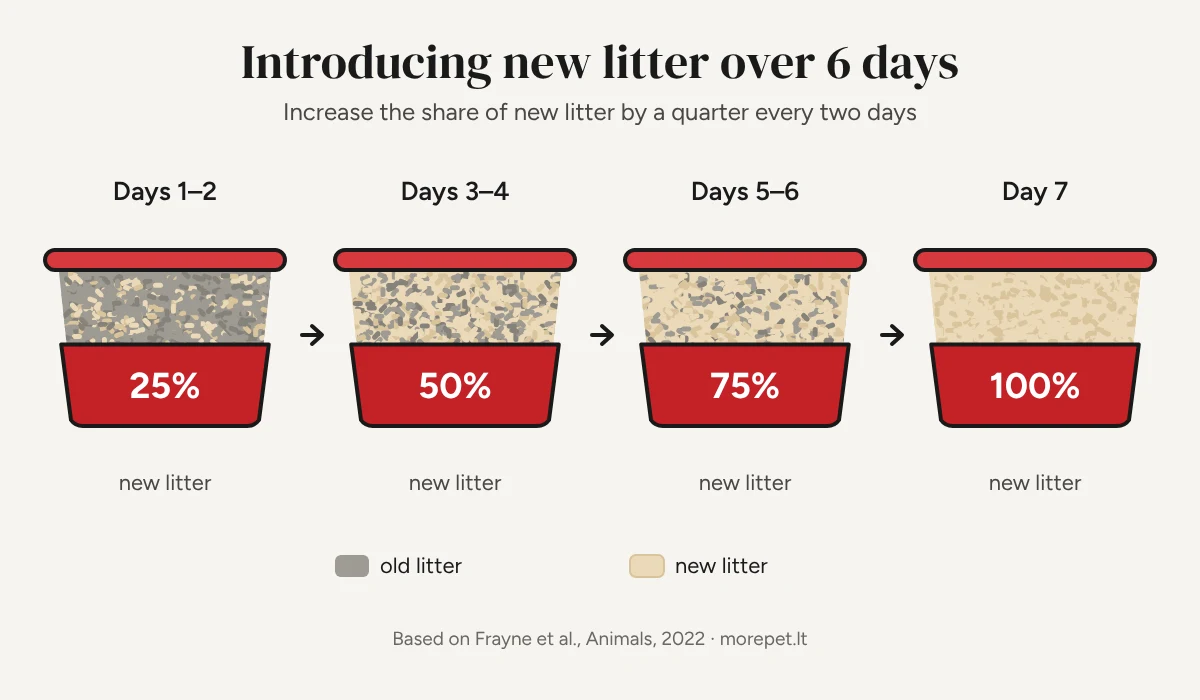
| Days | Old litter | New litter | What to watch for |
|---|---|---|---|
| 1–2 | 75% | 25% | Your cat may sniff for longer. That's normal. |
| 3–4 | 50% | 50% | Is your cat covering as usual? |
| 5–6 | 25% | 75% | Any accidents next to the box? |
| 7+ | 0% | 100% | Switch complete. Just daily care from here. |
- Start with a clean box. Tip out some of the old litter, scoop out the clumps and mix the remaining old litter with the new.
- Keep the usual depth. The total layer should stay the same as before, usually 5–7 cm.
- Mix, don't layer. Stir the new litter well into the old so your cat still feels a familiar texture and smell.
- Don't change anything else at the same time. While switching litter, keep the same box, location and lid.
- Watch and don't rush. If your cat struggles with a stage, go back one step and wait another 2–3 days.
For fussy cats: two boxes side by side
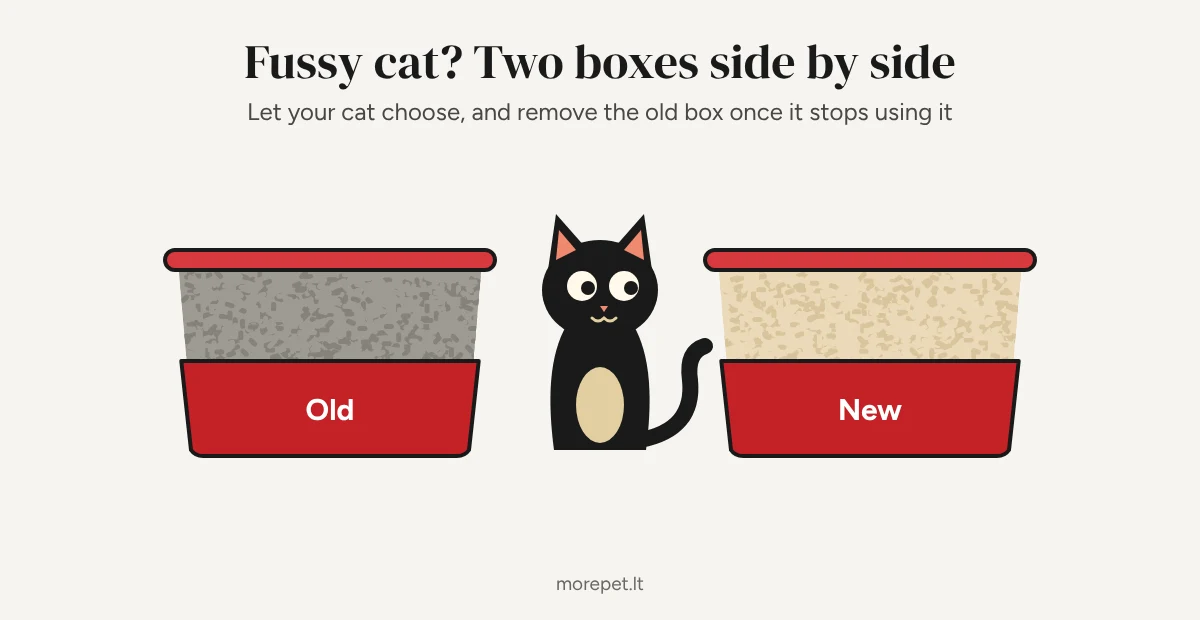
If your cat is very sensitive to change, you can let it choose instead of mixing. Put a second box filled only with the new litter next to the old one and see which it uses. Once your cat is using the new one regularly, gradually remove the old box.
The authors of the Frayne et al. study also suggest that getting to know the new litter in advance may make the transition easier, though this still needs testing in larger studies. The two-box method does exactly that.
What else helps: 5 tips
Scoop every day. In this study, cats clearly avoided boxes with visible used-litter clumps, and the more clumps there were, the stronger the avoidance. Odour on its own had little effect on their choice. Cleanliness matters even more during a switch, when your cat is already weighing up something new.
Make sure the box is big enough. 74 cats in 43 homes had two boxes for 28 days: a standard one and a large one (86 cm long). About 61% of the time, the cats chose the larger box. If your current box is small, a bigger one can make a litter switch easier too – just don't change both at once.
Have more boxes than cats. The general rule is at least one more box than the number of cats, and in a home with several floors, a box on each floor. In multi-cat homes, start the switch in all boxes at the same time.
Covered or open – habit matters more. Overall, 27 cats showed no preference for covered or open boxes, although some individual cats clearly preferred one type. So it's best not to change the box type during a switch.
Choose a mild scent for sensitive cats. A cat's sense of smell is far more sensitive than ours, which is why vets often recommend unscented litter. If you're moving to a scented litter, start a sensitive cat on the natural-scent version. More on scents and activated carbon in our cat litter research review.
Signs your cat doesn't like the new litter
- It stands on the edge of the box to avoid touching the litter.
- It shakes its paws afterwards or doesn't cover at all.
- It urinates or defecates next to the box, on a rug or in another soft spot.
- It sits by the box for a long time without going in.
If you notice these signs, go back one stage, or put a second box with the old litter alongside and switch more slowly.
When to see a vet: if your cat goes outside the box for more than a few days, keeps visiting the box but passes little urine, or you see blood in the urine, the cause may be a health problem such as urinary tract inflammation rather than the litter. In that case, talk to your vet.
Switching to tofu litter: what to know
Tofu litter is lighter than bentonite, less dusty and quickly forms firm clumps. When switching to it, a few questions come up most often:
- How much should I use? The same 5–7 cm layer as before. Tofu is lighter, so the same volume weighs less.
- Can I mix it with bentonite? Yes, during the switch. But while there is any bentonite in the mix, don't flush it: only urine clumps of pure tofu litter can go down the toilet.
- How do I dispose of it? Urine clumps can be flushed one at a time or composted (not for vegetable beds). Put faeces in a sealed bag with general waste.
- Which scent should I choose? For sensitive cats and kittens – natural scent. For multi-cat homes – with activated carbon. See all four scents.
Try MorePet tofu cat litter
Clumping, low-dust, plant-based. A 6 L bag lasts one cat about a month.
Sources
1. Frayne J., Shoveller A. K. et al. (2022). The Behavioural Impact on Cats during a Transition from a Clay-Based Litter to a Plant-Based Litter. Animals, 12(8), 946. MDPI
2. Ellis J. J., McGowan R. T. S., Martin F. (2017). Does previous use affect litter box appeal in multi-cat households? Behavioural Processes, 141, 284–290. Summarised in: Maddie's Fund
3. Guy N. C., Hopson M., Vanderstichel R. (2014). Litterbox size preference in domestic cats (Felis catus). Journal of Veterinary Behavior, 9(2), 78–82. AGRIS
4. Grigg E. K., Pick L., Nibblett B. (2013). A study of cats' preference for covered vs uncovered litter boxes. Summarised in: AVSAB
5. Roman N. Providing a Litter Box for a Cat. Merck Veterinary Manual (updated 2025). Merck Veterinary Manual