Can your cat’s litter box help spot kidney disease early? What a 2026 study shows
Chronic kidney disease is one of the most common illnesses in older cats. Studies report it in 30–40% of cats over 10 years old, and it is one of their leading causes of death. It is insidious because early signs are very subtle, and routine blood tests often show changes only once a large share of kidney function has already been lost.
In a study published in the journal Animals in April 2026, scientists from Nestlé Purina and The Ohio State University tested whether a smart litter box sensor could help pick up such changes.
How the study worked
- Weight sensors under the litter box recorded every visit: how long the cat urinated or defecated, how long it spent covering, and how much the waste weighed.
- The researchers compared cats diagnosed with kidney disease by a vet with cats of similar age with no known conditions.
- Data were collected in 2023–2025 at a research centre and in ordinary homes. The model was trained on 85 cats and tested on another 51.
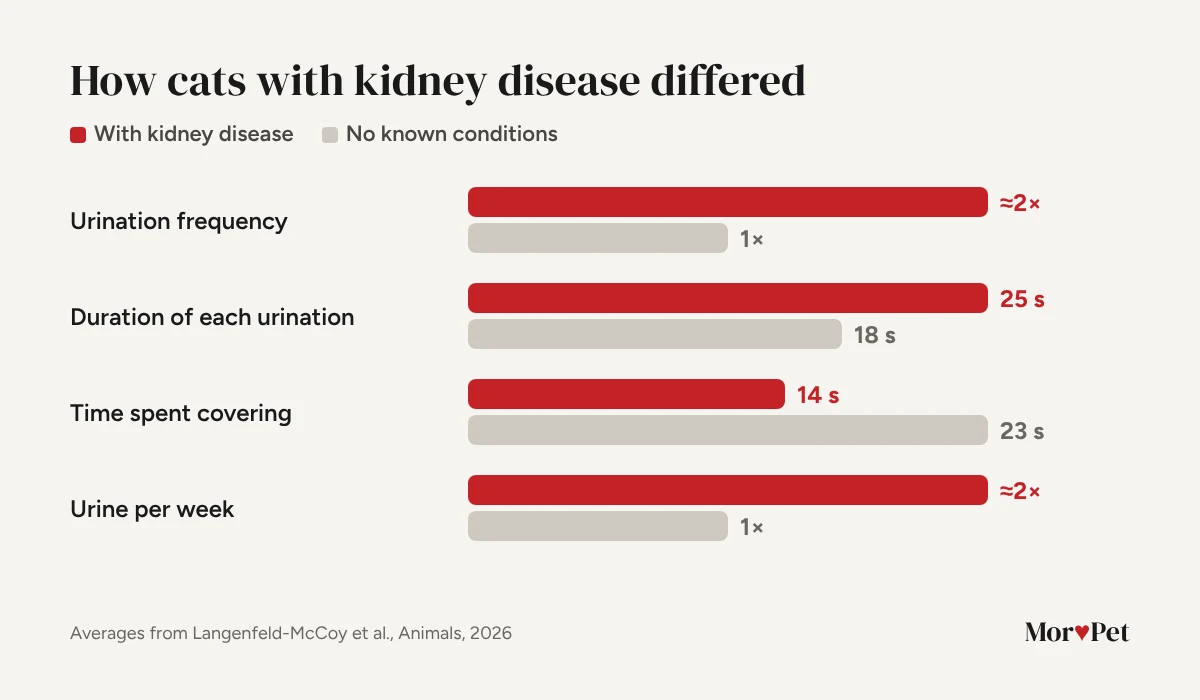
How cats with kidney disease differed
- They urinated about twice as often.
- Each urination lasted longer: 25 s on average, versus 18 s in healthy cats.
- They covered for a shorter time and less vigorously: 14 s on average, versus 23 s in healthy cats.
- Over a week they passed about twice as much urine (by weight).
How accurate was the model
In the group of new cats, the model’s accuracy score reached about 90%. Even so, it did not recognise every sick cat: of 7 new cats with kidney disease it identified 4, while the others behaved just like healthy cats. The study is also small (20 cats with kidney disease), some diagnoses were reported only by owners, and it was carried out by researchers from the sensor’s manufacturer. So this is a promising direction, but not a diagnostic tool.
What this means for you
You can watch for the same signs without a smart device:
- is your cat visiting the litter box more often;
- are there more urine clumps, and are they bigger;
- is your cat covering less;
- is it drinking more, and is it losing weight.
Clumping litter is especially helpful here: each urine clump is separate, so changes are easier to spot.
If you notice changes like these, talk to your vet. For older cats, vets recommend regular blood and urine tests, as they are still the most reliable way to detect the disease.
Try MorePet tofu cat litter
Forms firm clumps, low-dust, plant-based. Easy to see how many clumps form and what they look like.
Source
Langenfeld-McCoy N. et al. “Enhancing Detection of Feline Chronic Kidney Disease Through Smart Litter Box Monitoring”. Animals, 2026, 16(9):1319. doi.org/10.3390/ani16091319